Reese’s trauma after sexual assault
Off CampusReese’s trauma after sexual assault is an ongoing condition rather than a single past incident: it surfaces in his immediate responses to unexpected arrivals, his guarded relationship with the college environment where he was harmed, and the difficulty of navigating touch and trust. His account links the assault to social withdrawal and disrupted sleep, while his later interactions with Tom show a gradual, negotiated effort to regain agency. The narrative gives particular weight to the difference between understanding a boundary and honoring it in practice.
Assault and delayed disclosure
Reese tells Tom that his roommate from the previous year was an athlete who generally ignored him, but joined in when teammates visited. They insulted Reese with homophobic slurs and humiliating sexual questions. One night, while Reese was asleep, the roommate and others came into the room and assaulted him. Reese had been drinking at a party and could not remember who had walked him back to the dorm or identify everyone involved; he could name only his roommate with certainty.
The uncertainty about the other assailants compounds the difficulty of reporting what happened. Reese says that he did not tell anyone immediately, so there was little the college could do at first. The disclosure that brought his situation to attention was not a direct report of the assault: he was reported for possessing sleeping pills without a prescription. He confirms that he had difficulty sleeping, but clarifies that sleeplessness was not the reason he had the pills. The account leaves that distinction unresolved rather than turning it into a complete explanation.
Reese says that returning to Perkins was conditional on what the college had promised his father, who otherwise would have gone to the press. That arrangement places his return in the shadow of both the assault and its possible public exposure. The evidence does not reduce the college’s response to a settled judgment about its conduct: it shows Reese’s delayed disclosure, the limited action possible before he spoke, and the condition attached to his return.
Trauma in everyday life
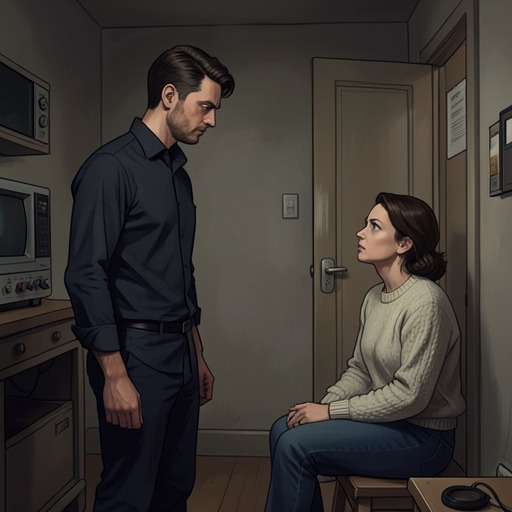
Reese’s reactions appear before he explains them. When someone pounds on the dorm-room door without warning, he pulls a desk chair between himself and the entrance, gripping it so tightly that his hands turn white. On another occasion, Tom enters and finds Reese turning abruptly, moving the same chair between them and holding it as though prepared to defend himself. Tom freezes, recognizing that Reese is not pretending. These repeated gestures make the room’s entrance a point of danger for Reese even when the person arriving is Tom, his roommate.
The response also emerges in a social encounter. When Cash makes intrusive, homophobic remarks, Reese does not answer; Tom notices that he appears to be shaking and intervenes by taking Cash out of the room. Reese’s silence is distinct from his usual readiness to speak up to Tom. The contrast suggests how the comments and the presence of another person can narrow his ability to respond, while Tom’s intervention stops the immediate humiliation without erasing the history behind it.
Reese describes himself as badly affected, and Tom connects that distress to a pattern in Reese’s daily life: he avoids drinking, parties, and much socializing, with Steph as a notable friend, while studying extensively. Tom also sees a mismatch between that isolation and Reese’s brief, impersonal sexual encounters. The narrative presents this behavior as a troubling way of coping with PTSD, not as evidence that Reese is unhurt or freely comfortable with intimacy. His outward choices and his sudden defensive reactions coexist; neither cancels the other.
Trust, choice, and physical boundaries
After Reese explains his history, Tom tries not to rush him with questions. When Reese acknowledges that his reactions may not seem normal, Tom answers that no one is entirely normal and tells him he seems mostly okay, though jumpy. Reese’s disclosure and Tom’s effort to listen establish a different kind of exchange from the unsolicited attention and degrading remarks he has faced elsewhere. The scene does not suggest that reassurance resolves the trauma; it establishes that Reese can describe it and be heard.
The distinction between chosen intimacy and imposed control becomes explicit when Reese and Tom begin kissing and Tom’s actions intensify. Reese says, “Wait.” Tom stops and lets go. Later, as they negotiate further contact, Reese tells Tom that he may touch him but must not hold him down or move his body. Tom agrees and proceeds with touch only after Reese has stated what is acceptable. Reese’s permission is specific: it grants room for contact while retaining his authority over how his body is handled.
The care required in these exchanges is not effortless. Before attempting a new form of intimacy, Tom has spent hours considering how to avoid bringing Reese’s bad feelings to the surface. Even so, a pillow hitting the floor startles Reese and makes him step back. The moment shows how an ordinary, unintended sound can disrupt a carefully considered plan. Tom’s anticipation alone cannot guarantee safety; Reese’s response remains his own, and the scene’s significance lies in the need to notice it and adjust rather than treat consent as a one-time assurance.
Relationship pressures and recovery
Reese’s trauma intersects with the tension in his relationship with Tom, but it is not the only source of that tension. Tom fears that news of his private life will become public gossip because his family has already been subject to intense media attention. He distinguishes being with his boyfriend from having many people know and discuss his private life, and Reese understands that this fear is real while also expressing its cost. When Tom corrects Reese’s use of “gay” by insisting that he is bisexual, he immediately recognizes that the correction can sound like another denial of Reese. Their disagreement about disclosure therefore concerns privacy and public exposure, but it also affects Reese’s sense of being acknowledged by his partner.
Reese tells Tom that being with him on one occasion made him feel bad, and that his capacity for distress was already full. This statement gives the relationship a limit: Tom’s fear and need for privacy do not make Reese responsible for absorbing their consequences. Their closeness requires more than physical permission; it also requires attention to the emotional weight Tom’s choices place on Reese.
Reese’s trauma is represented through delayed telling, repeated defensive gestures, social retreat, and moments when consensual intimacy must be carefully distinguished from past coercion. The narrative does not make romance a substitute for recovery. Instead, Reese’s boundaries, his ability to disclose what happened, and the uneven work of communicating with Tom remain visible as parts of his continuing effort to regain control and safety.